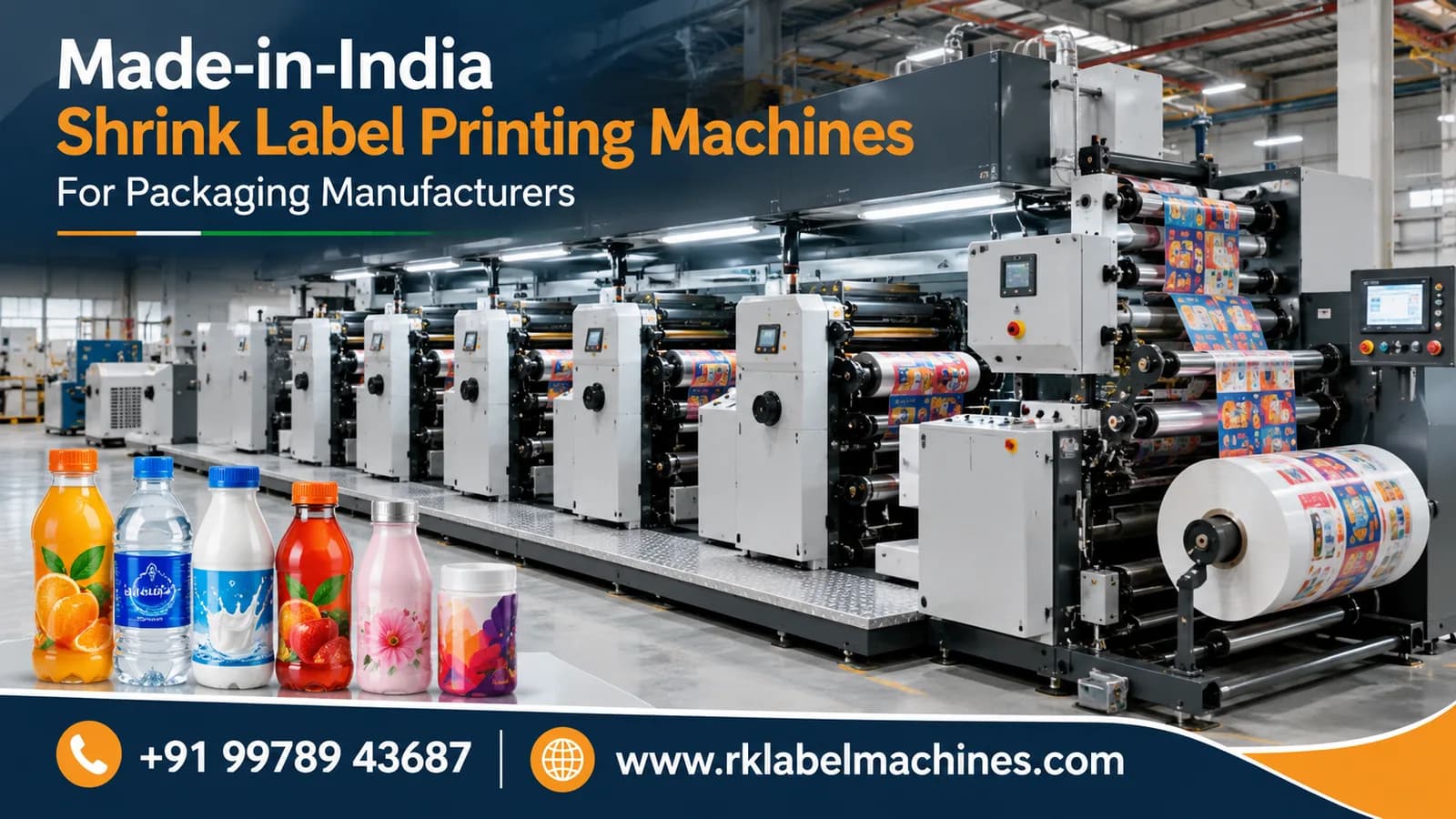
Packaging manufacturers need printing equipment that can handle thin films, maintain accurate registration, control web tension, and support consistent production. Shrink sleeve production adds another challenge because the printed film must remain stable during printing and drying before it reaches the sleeve-forming and shrinking stages.
For manufacturers evaluating a shrink label printing machine, the right configuration depends on the film type, film gauge, required colours, print dimensions, artwork orientation, finishing requirements, and expected production volume. These factors matter when a business plans to invest in machinery for beverage, dairy, FMCG, personal care, pharmaceutical, or other packaging applications.
Why Made-in-India Printing Machinery Matters for B2B Manufacturers
Indian packaging companies increasingly need machinery that fits their actual production requirements rather than a fixed standard setup. A machine manufacturer that can discuss film specifications, sleeve sizes, production volumes, and finishing requirements can help buyers define a more suitable configuration.
RK Label Printing Machinery Pvt. Ltd. manufactures label printing and converting machinery in Ahmedabad, Gujarat. According to the company's website, RK has manufactured label machinery since 1995, operates three manufacturing units, and supplies customers across 23+ countries. The company also provides custom-built machinery based on customer requirements.
For B2B buyers, this approach can be useful when a production line needs to match specific substrates, dimensions, printing requirements, or downstream processes.
Understanding the Shrink Sleeve Printing Machine: Full Servo 6 Colour
The RK shrink sleeve printing machine, Full Servo 6 Colour, runs a servo drive on every printing station. For shrink sleeve work, the configuration discussed here uses six flexographic printing units, built on the RK FMS Full Servo flexo printing machine platform. The machine includes UV and hot-air drying, a chiller drum, automatic plate registration, an ultrasonic electronic web guide, load-cell tension control, and online rotary die cutting.
Shrink sleeves wrap the full circumference of a container, so the printed film is wider than a typical front label. For that reason RK builds the shrink sleeve machine in 450, 550 and 670 mm web widths, to suit the customer's sleeve size. A 450 mm web prints up to 440 mm wide.
The specifications for this configuration include:
- Printing units: Six-colour flexographic printing, one servo drive per station
- Colour range: 2 to 12 colours (six colours in the configuration discussed here)
- Servo motors: Nine Schneider / Inovance servo motors
- Web width: 450, 550 or 670 mm
- Maximum print width: 10 mm less than the web width (440, 540 or 660 mm)
- Maximum print length: 650 mm
- Repeat range: 200 to 650 mm
- Production speed: 100 to 120 m/min with the UV dryer
- Unwinding and rewinding roll diameter: Up to 1000 mm
- Substrate range: From 12 micron film
- Drying: All-UV dryer system from UV Rays / GEW (made in Italy / UK) and hot-air drying
- Registration: Automatic plate registration
- Die cutting: Online rotary die cutting with waste matrix rewinding, one to three die-cutting units
- Anilox system: Individual motorized anilox roll system for each printing unit
- Control: Fully touchscreen control system
- Dimensions: Height 8 Ft, Width 6 Ft, Length 18.5 to 40 Ft (machine size differs with the colour configuration and the machine configuration)
These specifications describe the published configuration. Actual production output can vary according to film, artwork, ink system, and job requirements.
How the Machine Supports Shrink Film Production
Shrink film behaves differently from conventional paper label stock. Heat can affect the film, while uncontrolled tension can create problems during printing. This makes web handling and temperature management important parts of the production process.
The RK configuration addresses these requirements through several integrated systems.
Chiller Drum for Film Temperature Control
The machine uses a chiller drum system. After the drying process, the film passes over the chiller drum to help bring its temperature down.
This arrangement supports dimensional stability during printing. RK states that the chiller drum helps the machine hold registration on films as thin as 12 micron.
Full Servo Drive System
Each printing station runs on its own servo drive instead of a common gear train. The control system keeps every station in step with the web, so registration can hold from the start of the roll to the end.
The published configuration includes nine servo motors from Schneider / Inovance, driving the six printing units, the die-cutting unit, the infeed and the outfeed. Individual drive control supports coordinated machine operation and accurate web movement. For packaging manufacturers, this can be particularly relevant when jobs require controlled registration across multiple colours.
Automatic Registration
The machine includes an automatic plate registration system. It brings the plates into position electronically at the start of the job, which reduces setup waste on expensive film.
Accurate registration becomes especially important when a sleeve contains multiple colours, fine artwork, text, or branding elements.
UV and Hot-Air Drying Options
The published configuration includes an all-UV dryer system from UV Rays / GEW, made in Italy / UK, along with hot-air drying for the printing units. UV inks cure under the lamps, while water-based and solvent-based inks dry under hot air.
Having both drying systems gives manufacturers configuration flexibility for different production requirements. The appropriate ink and drying setup should always match the actual substrate and job specifications.
Before finalising a machine, buyers should discuss their film samples, ink requirements, artwork, and expected production conditions with the manufacturer.
Reverse Printing for Shrink Sleeves
Shrink sleeve artwork often requires printing on the inside surface of the film so the graphics remain protected after the sleeve forms around the container.
RK offers a turn bar for back-side or reverse printing on this machine. The turn bar changes the web orientation within the printing process, allowing the required printing arrangement in the same production flow.
This feature can support packaging jobs where artwork orientation and sleeve construction require reverse printing.
Online Die Cutting and Finishing Options
The machine includes an online rotary die-cutting section, with one to three die-cutting units, and waste matrix rewinding. This allows cutting to take place within the production line when the job requires it.
The published option list also includes a cold foil / lamination unit, delam-relam, a sheeter stacker, snowball rewinding, and a video monitor. These options can support jobs that require additional finishing or layered material handling.
For B2B buyers, it is important to decide which finishing functions the production line actually needs before ordering the machine. Adding unnecessary equipment can increase investment and complexity, while leaving out a required process can create additional downstream work.
What Materials Can the Machine Handle?
The shrink sleeve configuration is designed for PVC shrink film and other thin shrink films from 12 micron upward. The FMS platform also runs self-adhesive stock, paper, BOPP, and PET within its substrate range of 12 micron to 200 GSM. The company recommends sharing actual film samples before finalising the specification because film behaviour depends on gauge, ink system, and drying requirements.
This sample-based approach matters for industrial buyers because substrate performance can vary from one material specification to another.
Applications for Packaging Manufacturers
The machine is positioned for several packaging applications, including:
Beverage Packaging
Manufacturers can use shrink sleeves for water, juice, soft drinks, and energy drink bottles where full-wrap artwork supports product branding.
Dairy and Food Packaging
Shrink sleeves can provide 360-degree branding for cups, bottles, and tubs.
Personal Care and Cosmetics
Products such as shampoo, lotion, and cosmetic containers can use sleeves as a major branding surface.
Pharmaceutical and Nutraceutical Packaging
Shrink sleeves can carry product information, regulatory text, and tamper-evident elements, depending on the packaging design.
Promotional and Multipack Packaging
Shorter promotional runs and seasonal packaging can also use printed shrink sleeves.
Bottle Cap and Neck Sleeves
Tamper-evident and decorative neck bands can be printed on the same line.
How B2B Buyers Should Select the Right Configuration
A packaging manufacturer should evaluate the machine against actual production requirements rather than choosing specifications based only on machine speed.
Consider these factors:
- Film type and gauge – Confirm whether the planned substrate matches the machine configuration.
- Colour requirements – Determine whether six colours meet your regular artwork requirements. The FMS range is available from 2 to 12 colours.
- Web and print width – Choose the web width, 450, 550 or 670 mm, from your sleeve size and the number of sleeves across the film.
- Reverse printing – Check whether your artwork requires inside-surface printing.
- Finishing requirements – Decide whether online die cutting, cold foil, lamination, or delam-relam functions fit your jobs.
- Production volume – Share expected monthly output with the manufacturer.
- Sleeve dimensions – Provide sleeve sizes and artwork dimensions.
- Floor space – Request the machine layout and confirm operating space.
- Downstream equipment – Plan sleeve glueing and cutting together with the press. RK builds the RK PSG 650 PVC shrink sleeve glueing machine and the RK PSC 320 PVC shrink sleeve cutting machine.
Sleeve Glueing and Cutting: RK PSG 650 and RK PSC 320
Printed shrink film becomes a sleeve on two further machines. The RK PSG 650 is a PVC shrink sleeve glueing machine for film up to 650 mm wide, running at up to 120 m/min. The RK PSC 320 is a PVC shrink sleeve cutting machine for 320 mm film, cutting at 15,000 to 18,000 strokes per hour.
In the line, the printed film is glued into a sleeve first on the PSG 650. The glued flat sleeve is half the width of the printed film, so it fits the PSC 320 cutting machine. Because RK builds the printing press and both sleeve machines, a buyer can discuss the whole line with one manufacturer.
Conclusion
For packaging manufacturers, choosing printing machinery requires more than checking speed or colour count. Film behaviour, temperature control, tension, registration, drying, reverse printing, finishing, and downstream sleeve production all need consideration.
The RK Full Servo 6 Colour shrink sleeve printing machine configuration for shrink sleeves combines six-colour flexographic printing in 450, 550 and 670 mm web widths with nine Schneider / Inovance servo motors, a chiller drum, UV and hot-air drying, automatic plate registration, optional reverse printing, and online die cutting. Manufacturers can discuss their film, sleeve dimensions, artwork, and production requirements with the RK engineering team before finalising the configuration.
For businesses evaluating a shrink sleeve label printing machine, reviewing the actual substrate, production volume, finishing requirements, and complete line configuration with the manufacturer can help create a more suitable B2B production setup.