When you buy a thermal paper slitting machine, core size is one of the specifications you should check before placing an order. The core sits inside the finished paper roll and affects how the roll fits on a printer, spindle, shaft, or other equipment.
A wrong core size can create problems during rewinding, handling, storage, and final use. For B2B manufacturers, the right core specification can also help improve production consistency and reduce unnecessary roll changes.
So, what core sizes should you consider when buying a thermal paper roll slitting machine? The answer depends on your finished roll requirements, target customers, printer compatibility, roll diameter, and production process.
What Is the Core Size of a Thermal Paper Roll?
The core is the tube at the center of a paper roll. Core size usually refers to the inside diameter (ID) of this tube.
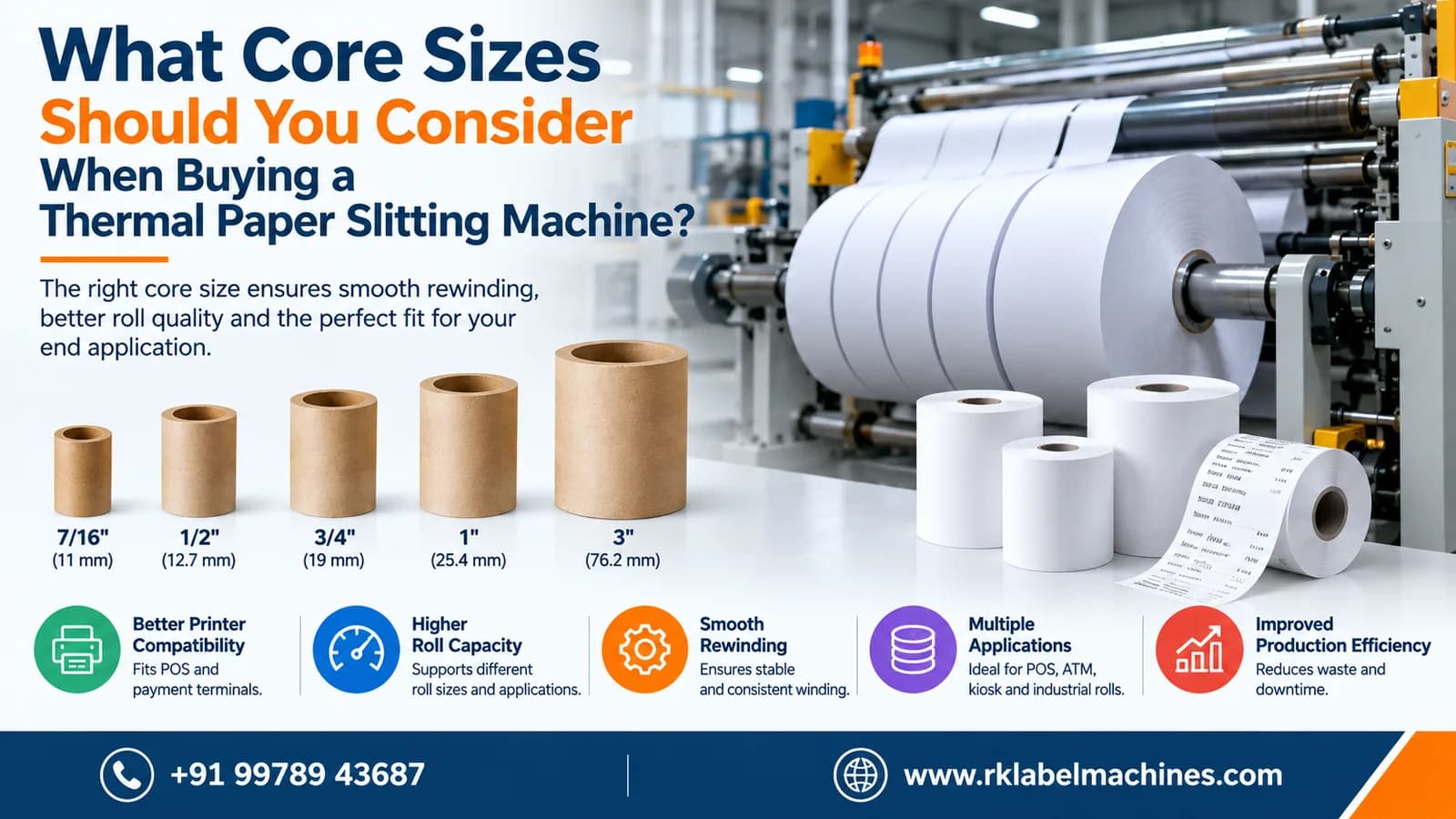
Thermal paper rolls use several core IDs. The RK TS-500 ships with three standard rewind shafts:
- 13 mm, which runs the common 12 mm POS core
- 19 mm
- 25.4 mm (1 inch)
If your customer's printer needs a different core, tell RK the size and RK makes a rewind shaft for it.
The right core depends on the printer or terminal that will use the roll. Printer makers publish the spool size. The Epson TM-T82 receipt printer, for example, takes a roll core of 12 mm inside diameter and 18 mm outside diameter, and a roll up to 83 mm across. Suppliers write the small POS core as 12 mm, 12.7 mm (1/2 inch) or 13 mm. Small cores suit POS and card machine rolls. Larger cores suit ATM and kiosk rolls.
Rolls for some export markets use an 11 mm (7/16 inch) core. RK makes a rewind shaft for that size on request.
Why Core Size Matters in Thermal Paper Slitting
Core size affects more than the cardboard tube. It connects your slitting and rewinding process with the requirements of your final customer.
1. It Affects Printer Compatibility
The finished roll must fit the customer's printer or terminal. For example, many POS thermal paper applications use small core sizes, while industrial thermal printing systems can use larger cores.
Card machines and handheld terminals take narrow rolls, and desktop billing printers take wider ones. The section on small cores below lists the common Indian sizes.
2. It Influences Roll Capacity
Core diameter works together with the finished roll's outside diameter. A larger core can support a larger roll configuration, depending on the machine and printer specifications.
3. It Affects Rewinding
Your thermal paper slitting machine must accommodate the core size you want to produce. The rewinding shaft, core chuck, shaftless system, or core holders need to match the required dimensions.
The RK TS-500 rewinds on manual shafts for 13 mm, 19 mm and 25.4 mm cores, with three shafts of each size and a maximum rewind roll of 200 mm.
4. Shaft Size Decides How the Roll Winds
The rewind shaft carries the core while the roll winds, so the shaft has to match the core inside diameter. A shaft smaller than the core lets the core turn loose on the shaft. The roll then winds with uneven tension and the edges wander. A shaft larger than the core will not slide in, and it can split a cardboard core.
For that reason RK supplies the TS-500 with 13 mm, 19 mm and 25.4 mm shafts, three of each, and makes any other shaft to the customer's core. The 13 mm shaft covers the small POS and card machine core. The 25.4 mm shaft covers the 1-inch core used on larger rolls.
Which Core Sizes Should B2B Buyers Consider?
There is no single core size that fits every thermal paper application. Start with your customer's final roll specification.
Small Cores for POS and Compact Rolls
Small cores can suit POS, payment-terminal, mobile-printer, and compact receipt-roll applications.
Before production, confirm:
- Required core ID
- Finished roll width
- Maximum roll diameter
- Paper GSM
- Required roll length
- Printer or terminal model
Roll sizes are written two ways. Most Indian sellers write width x length in metres, such as 79 mm x 50 m. Many exporters write width x outside diameter in millimetres, such as 57 mm x 40 mm. Both describe the same roll, so confirm which one a customer means. The two common widths are 57 mm (58 mm on some printers, and some Indian sellers list 56 mm) and 79 mm (80 mm). The Epson TM-T82 guide lists the paper width as 57.5 mm and 79.5 mm, each within 0.5 mm.
Common POS and card machine rolls in India, on a 12 to 13 mm core:
| Width | Outside dia (approx.) | Length | Used in | Core |
|---|---|---|---|---|
| 57 / 58 mm | 40 mm | 15 m | Card swipe / EDC machines | 12 - 13 mm |
| 57 / 58 mm | 50 mm | 25 - 30 m | Handheld billing printers | 12 - 13 mm |
| 57 / 58 mm | 60 - 70 mm | 40 - 50 m | Small billing counters | 12 - 13 mm |
| 79 / 80 mm | 50 mm | 25 m | Desktop billing printers | 12 - 13 mm |
| 79 / 80 mm | 60 - 80 mm | 40 - 50 m | Retail, restaurant, petrol pump POS | 12 - 13 mm |
| 79 / 80 mm | 80 - 200 mm | varies | ATM and kiosk printers | 12.7, 18 or 25.4 mm |
Outside diameter and length depend on the paper thickness. The length of a roll is close to 3.14 x (D x D - d x d) / (4 x t), where D is the roll outside diameter, d is the core outside diameter and t is the paper thickness, all in mm. For example, a 60 GSM roll (about 0.08 mm thick) of 70 mm outside diameter on a core of 13 mm inside and 17 mm outside diameter holds about 45 m. A 57 mm x 40 mm roll holds 10 to 20 m and a 57 mm x 50 mm roll about 24 m, on a 13 mm core.
Check the printer manual for the largest roll it takes. The Epson TM-T82 takes rolls up to 83 mm outside diameter, so a 50 m roll of 79 mm width fits and a 200 mm ATM roll does not.
Common paper GSM in India is 48 to 70 GSM, with 48 and 55 GSM used the most.
25.4 mm (1-Inch) and Other ATM Cores
ATM and kiosk rolls are larger in diameter, from 80 mm to 200 mm, and their cores vary by machine. Suppliers list 12.7 mm, 18 mm and 25.4 mm ATM cores. A 25.4 mm core has a larger internal diameter and carries a heavier roll. RK makes the rewind shaft to whichever ATM core the customer uses.
Other Core Sizes
If your customer uses a core that is not 13 mm, 19 mm or 25.4 mm, RK makes the rewind shaft to your core size. Send the core inside diameter with your enquiry.
What Should You Ask a Machine Manufacturer?
Before purchasing a thermal paper slitting machine, ask the manufacturer these questions:
- What is the minimum rewinding core ID?
- What is the maximum rewinding core ID?
- Can the machine handle multiple core sizes?
- Can operators change core sizes quickly?
- What is the maximum finished roll diameter?
- What is the minimum slitting width?
- What thermal paper GSM range can the machine process?
- Does the machine use pneumatic or mechanical core holding?
- Can the machine maintain consistent tension for different roll sizes?
- Can the manufacturer customize the rewinding system?
These questions help you compare machines based on your actual production requirements rather than only comparing speed or price.
Which RK Machine Fits?
The RK TS-500 thermal paper slitting machine slits and rewinds POS rolls. It takes a 500 mm paper width, runs up to 165 m/min and unwinds jumbo rolls up to 1000 mm on a 3-inch air shaft. The rewind side takes rolls up to 200 mm. It handles thermal paper up to 100 GSM and has a rotary blade cutting system, automatic ink marking, a meter counter with auto stop and a Schneider PLC.
The TS-500 with one colour printing unit prints on the roll before slitting. The TS-500 with two colour printing adds a second colour. The unwind and rewind sides are the same on all three machines.
How to Select the Right Core Size
Use this simple B2B selection process:
Customer requirement → Finished roll specification → Core ID → Roll OD → Slitting width → Rewinding system → Machine configuration
Also measure the core and finished roll rather than relying only on product names such as "POS roll" or "thermal roll." Thermal roll specifications normally depend on multiple measurements, including width, outside diameter, core ID, and winding direction.
Conclusion
Core size is a small measurement with a significant impact on thermal paper converting. When selecting a thermal paper slitting machine, do not focus only on machine speed or purchase price. Match the rewinding system with the core sizes your customers actually need.
For manufacturers producing POS, receipt, ATM, kiosk, or industrial thermal rolls, a clear specification sheet covering core ID, roll width, roll diameter, GSM, winding direction, and production volume can make machine selection much easier.
To get a quotation, send RK your roll width, outside diameter, core size and GSM. Call or WhatsApp +91 99789 43687, email info@rklabelmachines.com, or fill in the enquiry form on any RK machine page. RK will configure the TS-500 to your roll sizes.