Machine Accessories
Rubber Roll for Label Printing and Converting Machines
01 — Overview
Rubber Roll Manufacturer in India for Label Machines
A label machine moves its web through a series of rolls, and several of them must grip, press or feed the material without marking it. Those are the rubber rolls. A nip roll pulls the web forward with a steel roll on the other side; an ink rubber roll carries ink onto the web in a marking unit; a pressure roll presses one layer onto another in a pasting machine. In every case the rubber covering has to be the right hardness, the right thickness and ground true, or the web slips, wrinkles or is marked.
RK Label Printing Machinery Pvt. Ltd. makes and supplies rubber rolls for its own machines and for converters in India who need replacements or re-covered rolls. The RK POS roll slitting machine with one colour printing, for instance, uses an automatic ink marking system with an ink rubber roll; the multi layer pasting machine and the wrist band machine carry nip rolls in their feed and die cutting units. RK supplies these rolls to the machine's shaft, diameter and face length.
This page explains what a rubber roll does on a label machine, where it is used, how to specify one and how to get a quotation from RK.
02 — Specifications
Technical Specifications
Technical Specifications
Rubber rolls are made to order for the position and machine they will fit. RK needs the following for a quotation:
- Machine make and model, and the position of the roll (nip, pressure, ink marking, idler)
- Overall length, face length and finished diameter
- Core diameter and shaft end details, or the old roll for reference
- Rubber hardness required (Shore A), if known, or the material the machine runs
- Quantity, and whether the order is for new rolls or re-covering of existing cores
03 — What Is It
What Is a Rubber Roll?
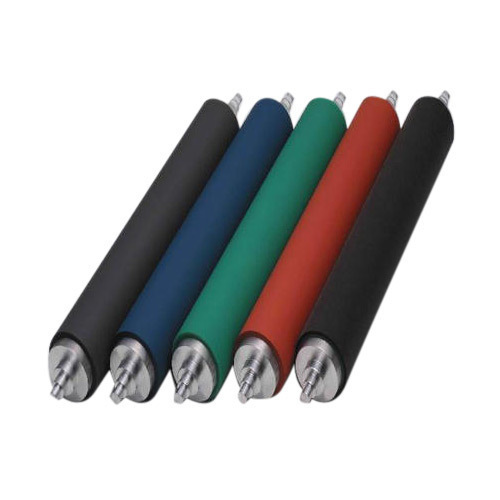
A rubber roll, also called a rubber roller, is a steel core covered with a layer of rubber or a similar elastomer, ground to a precise diameter. The core carries the bearings or shaft ends that mount the roll in the machine. The covering gives the roll grip and a small amount of give, so it can press against a hard roll or a web without damaging either.
On label printing and converting machines, rubber rolls appear as nip rolls in feed and rewind units, as pressure rolls in pasting and laminating stations, as ink rolls in simple marking units and as idlers where the web must be guided without slipping. The hardness of the covering, measured in Shore A, is chosen for the duty: a softer roll conforms to the web for gentle contact, a harder roll gives precise nip pressure and longer life.
04 — Key Features
Key Features of the RK Rubber Roll
Even Contact Across the Web Width
The covering is ground parallel and concentric so the roll touches the web with the same pressure from edge to edge. Uneven contact is what causes the web to walk sideways or wrinkle at a nip.
Hardness Chosen for the Duty
RK selects the rubber hardness for the roll's job – nip feeding, ink marking, laminating pressure or guiding – and for the material the machine runs, from thin film to board and foam.
Made to the Machine's Shaft and Face
Each roll is made to the core diameter, shaft ends, face length and finished diameter of the machine it fits, so it drops into the existing bearings without modification.
Re-covering of Worn Rolls
An existing steel core in good condition can be stripped and re-covered instead of replaced, which is the usual route for nip and pressure rolls that have worn or been cut by a blade.
Used Across the RK Range
Rubber rolls are fitted in RK printing, slitting, pasting, inspection and die cutting machines, so the accessory is specified from working experience on the same machines.
Suitable for Ink Marking Units
RK supplies the ink rubber roll used in the automatic ink marking system of the POS roll slitting machine with one colour, and equivalent rolls for similar marking units.
05 — How It Works
How Does a Rubber Roll Work?
At a nip, the rubber roll is loaded against a driven steel roll with the web between them. The rubber flattens slightly at the contact line, forming a narrow band of pressure that grips the web over its full width and pulls it forward at the speed of the driven roll. Because the rubber conforms, small variations in web thickness are absorbed without the web slipping or being crushed.
In a pressure or pasting station, the same principle presses one layer onto another with an even force, so an adhesive layer bonds fully without air pockets. In an ink marking unit, the rubber roll picks up ink from a supply and transfers it to the web where the marking is needed. In each case the roll's hardness and its true grinding decide whether the contact is even; a roll that is too hard marks the web, one that is too soft or worn out of round lets it slip.
06 — Applications
Applications of the Rubber Roll
- Nip and feed units – pulling the web through slitting, inspection, rewinding and die cutting machines.
- Pasting and laminating stations – pressing layers together on the multi layer pasting machine and similar equipment.
- Ink marking units – the ink rubber roll on the POS roll slitting machine with one colour printing.
- Rewinding and unwinding units – lay-on and contact rolls that keep rewound rolls tight and straight.
- Die cutting units – nip rollers that feed the web into rotary die cutting, as on the RK wrist band machine.
- Replacement and re-covering – renewing worn nip and pressure rolls on existing machines.
07 — Materials
What Materials Can It Handle?
Rubber rolls on RK machines handle the full range of label and converting materials: self-adhesive label stock, paper and board, thermal POS paper, BOPP, PE, PET and PVC film, shrink film, foam and tapes. The rubber hardness and finish are chosen for the material – softer for thin film that must not be marked, harder for board and foam that need firm feeding – which is why RK asks what the machine runs before it quotes.
09 — Why RK
Why Choose RK Label Machines?
RK Label Printing Machinery Pvt. Ltd. has built label printing and converting machines in Ahmedabad, Gujarat since 1995, operates three manufacturing units and supplies customers in 23+ countries. Every RK machine carries rubber rolls in its feed, nip and pressure positions, so the company knows what hardness and finish each position needs on its own equipment. Ordering rolls from the machine builder means they are made to the original drawing rather than measured off a worn part, and RK can supply the powder brakes, cylinders and dies for the same machine at the same time.
10 — Selection Guide
How to Select the Right Rubber Roll
- Identify the position: nip, pressure, ink marking or idler. Each needs a different hardness and finish.
- Measure or send the old roll: overall length, face length, finished diameter, core and shaft details. The old roll is the safest reference.
- State the material: thin film needs a softer, finer-finished roll; board and foam need a harder one.
- New or re-cover: if the core and shaft ends are undamaged, re-covering is the practical option.
- Order in pairs where the machine uses pairs: replacing only one roll of a matched pair gives uneven nip pressure.
11 — Price
Rubber Roll Price in India
The price of a rubber roll depends on its length and diameter, the rubber type and hardness, whether it is a new roll or a re-covering of your existing core, and the quantity. Prices are quoted ex-works Ahmedabad with GST at 18% applicable. If an RK engineer fits the rolls at your plant, the engineer's transport and stay are borne by the customer. Send RK the roll dimensions and the machine details for a quotation.
12 — FAQ
It grips, feeds, presses or guides the web. Nip rolls pull the web forward, pressure rolls press layers together, ink rolls transfer ink in marking units and idlers guide the web without slipping.
None; both names describe the same part – a steel core with a ground rubber covering.
Among others, the POS roll slitting machine with one colour (ink rubber roll in the ink marking system), the multi layer pasting machine (nip roll) and the wrist band machine (nip roller in the die cutting unit).
Yes, if the core and shaft ends are in good condition. The old covering is stripped, a new one applied and ground to the required diameter.
Tell RK the roll's position and the material the machine runs. RK selects the Shore A hardness from that; if you have the old roll, its hardness can be checked.
Yes, provided RK has the dimensions – overall length, face length, diameter, core and shaft ends – or the old roll as a sample.
It depends on the duty, the material and whether blades or ink contact it. A roll should be replaced or re-covered when it shows grooves, flat spots or loses grip.
Common causes are a roll ground out of parallel, uneven nip loading, or a worn covering. A correctly ground rubber roll with even pressure across the width usually cures it.
RK Label Printing Machinery Pvt. Ltd., Ahmedabad, Gujarat, makes rubber rolls for its own machines and supplies them as an accessory.
Get Rubber Rolls Made to Your Machine
A worn nip or pressure roll shows up as slipping, wrinkling and marked labels long before it fails completely. Send RK Label Machines your machine model, the roll dimensions or the old roll, and the material you run, and the team will quote new rolls or re-covering to suit. Request a quotation today.
Get a Customized Machine Quote
Our engineers are ready to help you choose the right production line. Send us your requirements for a detailed proposal.

